Meaning + Access · Updated August 23, 2026
A Baby at the Ceremony: Practical Guide
How to include a baby in a wedding ceremony: feeding, naps, sound, seating, and a plan B
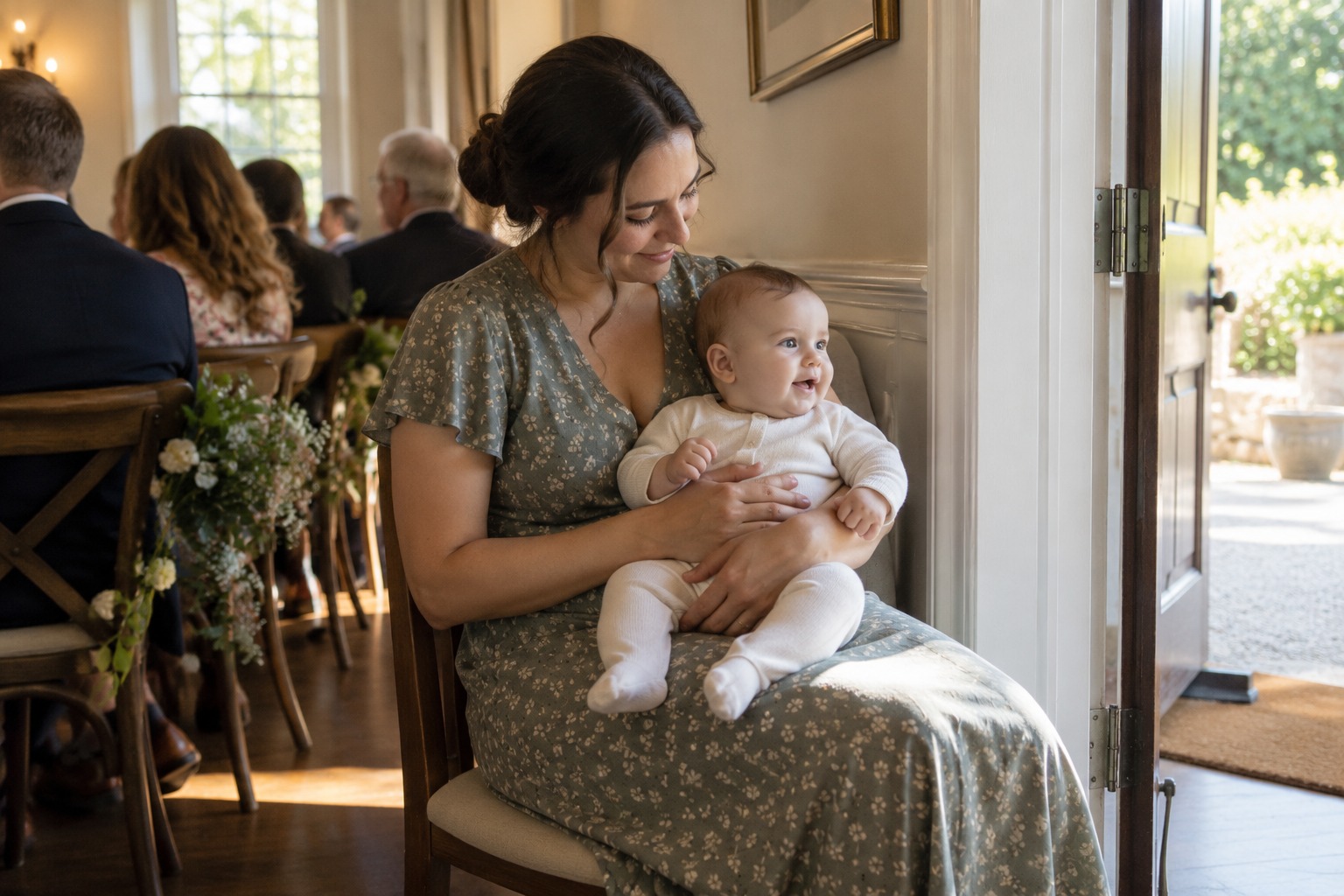
A baby can be part of a wedding ceremony, but the ceremony should not depend on the baby's cooperation. Plan the baby's role as optional, keep a caregiver free to leave the room, and treat feeding and sleep as fixed points around which the ceremony bends. The sections below cover the decisions that matter most: who holds the baby, how long the ceremony can run, what to do about noise, and how to write the words.
Who holds the baby, and who is free to leave
A baby at a ceremony needs one adult whose only job is the baby. That person should not be in the wedding party, should not read, and should not stand where they cannot step away. If both parents are in the wedding party, name a second caregiver in advance and tell that person where the exits are, where the diaper bag sits, and where they can go.
Seating follows from that. Put the caregiver on an aisle seat near the back or near a side door. A stroller parked at the end of a row blocks nothing and gives the caregiver a place to set the baby down. If the venue is a church, check whether the back vestibule or cry room is open; many are, and some have a speaker so the caregiver still hears the vows.
For a baby who is mobile, the calculus changes. A crawling or walking baby will not stay in one pair of arms for a twenty minute ceremony. Either accept that the caregiver will spend the ceremony at the back of the room, or give the baby a floor space at the edge of the seating with a quiet toy. This is where the practical side of Câlin Bout'chou becomes useful: its month by month material on play and daily rhythm is written for parents of children from birth to three, which is exactly the age range that shows up at family ceremonies.
How long can the ceremony run before a baby disrupts it?
Shorter is safer. A ceremony of fifteen to twenty minutes gives a baby a realistic chance of staying settled, especially if the baby has just eaten and is due for a nap. Beyond thirty minutes, plan for the baby to leave at some point, and make that departure normal rather than an interruption.
Build the ceremony so the baby's part comes early. A short entrance, a blessing, or a handoff of the rings can happen in the first five minutes, while the baby is still interested in the room. Long readings, unity rituals, and musical interludes can come after the baby has left.
Two scheduling points are worth protecting. First, feed the baby close to the start, not an hour before, so the baby is full rather than hungry during the vows. Second, if the ceremony falls at nap time, expect a tired baby and plan accordingly. Moving a nap is harder than moving a ceremony.
What about noise during the vows?
Noise is normal and does not need to be prevented. A baby who coos, babbles, or cries is not ruining the ceremony. The officiant should know in advance that a caregiver may stand up and walk out, and should not pause or comment when it happens.
That said, a few choices reduce the chance of a loud stretch during the most important words. Seat the baby away from the microphone and away from the musicians. Avoid handing the baby back and forth during the vows; every transfer is a chance for a protest. If the baby uses a pacifier or a comfort object, keep it within reach of the caregiver rather than in a bag at the front.
For outdoor ceremonies, wind and traffic add their own noise. A baby who is already unsettled will notice. Choose a spot for the caregiver upwind of any amplified speaker, and keep a light blanket available for shade and for a quick cover if the baby needs to nurse or take a bottle.
How do you write a baby into the ceremony words?
A baby can be named in the ceremony without being given a task. The simplest form is a sentence in the opening or the closing: the couple welcomes the child into the household they are forming, or acknowledges the family they already are. This works for a baby, a stepchild, or a child of either partner.
If the couple wants a physical moment, a short blessing over the baby is easy to stage. The officiant speaks two or three sentences, the caregiver holds the baby facing the couple, and no one has to remember a line. Avoid anything that requires the baby to hold, carry, or hand over an object; a ring pillow or a sign is a photo opportunity, not a reliable plan.
Readings can also be chosen with a baby in mind. A poem or passage about care, patience, or ordinary days fits a ceremony where a small child is present. Keep it short, and put it before the vows rather than after, so the baby's window of calm is used well.
What should the caregiver pack, and where should it go?
Pack for the ceremony, not for the day. A small bag with one bottle or a nursing cover, one diaper and wipes, a pacifier, a burp cloth, and one quiet toy covers most situations. Leave the rest in the car or with a second adult.
The bag should sit with the caregiver, not at the front of the room. If the venue has a cry room or a side space, put a second bag there so the caregiver does not have to return to the seating area. A change of clothes for the baby is worth including if the ceremony is long or the baby is very young.
For the couple, one more item matters: a designated person who can hold the baby during photos after the ceremony. Photos are the point where a tired baby and a tired caregiver both run out of patience. A grandparent or friend who takes the baby for twenty minutes after the vows makes the rest of the day easier for everyone.
What is the plan if the baby cannot stay?
The plan is that the baby leaves, and the ceremony continues. Decide in advance who takes the baby out, where they go, and how they signal that they are leaving. A caregiver who simply stands and walks to the back needs no signal at all, and that is usually the best arrangement.
If the couple wants the baby present for a specific moment, put that moment early and treat everything after it as optional. If the baby is asleep in a stroller at the back, leave the baby there; waking a sleeping baby for a photo is a trade that rarely pays off.
Finally, tell the officiant and the venue. An officiant who knows a baby may cry will not stop mid sentence, and a venue that knows a stroller is coming will not treat it as a problem. The ceremony is about the couple, and a baby in the room is part of the family the couple is making public. Planning around the baby is not a concession; it is the same care the vows describe.
Source check · reviewed September 15, 2026
Source note
From the desk
Notes on the desk
Next move
Put this into a rehearsal-ready brief.
The Decision Deck stores nothing by default. It turns the questions above into a local checklist, sequence, and vendor prompts.
Keep planning

Meaning + Access
Meaningful Wedding Ceremony Traditions
Make meaning with context, consent, and care.
Meaning + Access
Accessible Wedding Ceremony Planning
Plan communication, movement, and sensory comfort early.
Meaning + Access
Gender Inclusive Wedding Language
Choose ceremony language that names the people present.
Meaning + Access