Meaning + Access · Updated August 23, 2026
Ceremony When Children Live Between Two Homes
How to plan a wedding or family ceremony when children split time between two homes: roles, timing
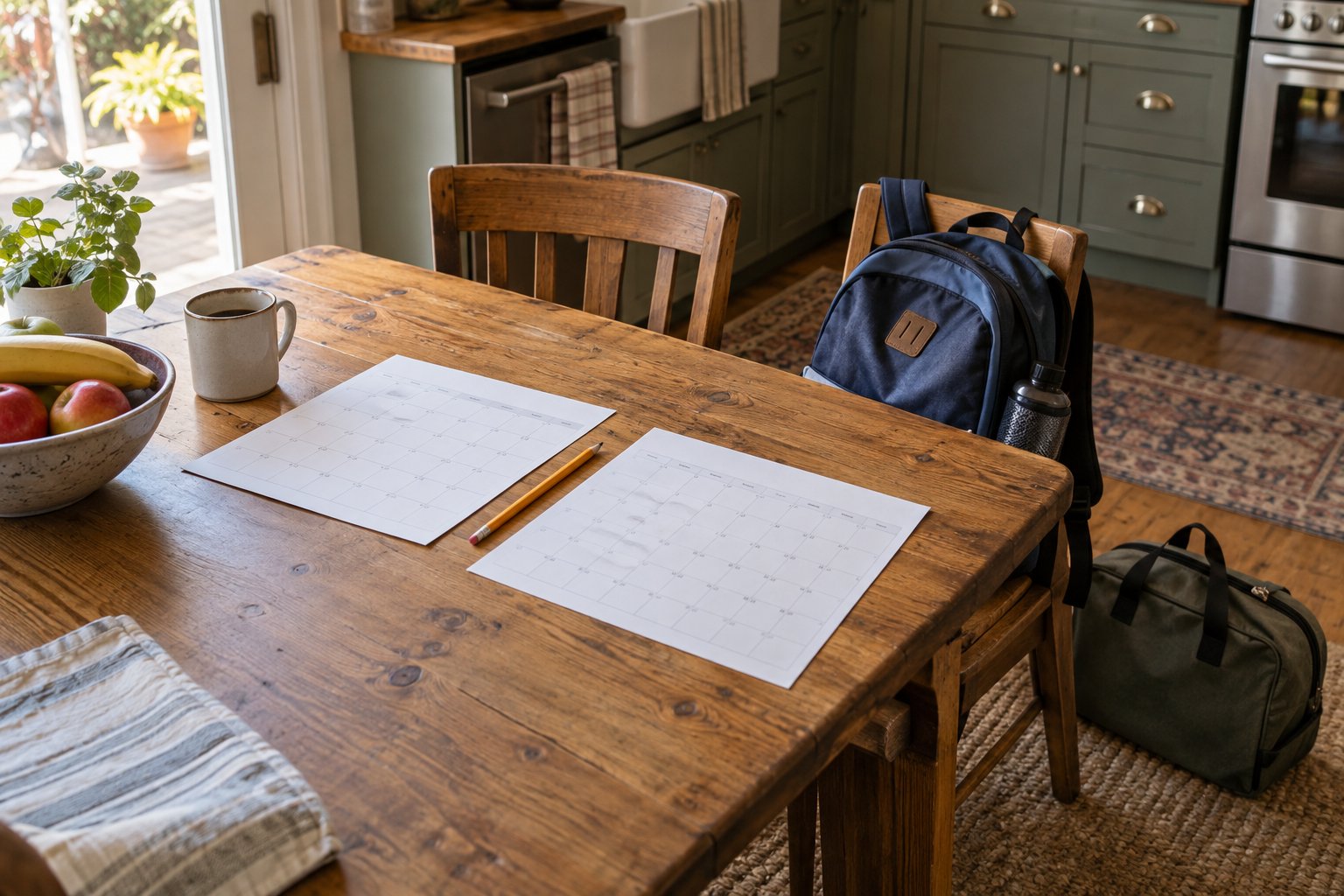
A ceremony works when children living between two homes are given a defined part in it, a realistic time slot, and a clear signal that both households are expected. Build the plan around the children's existing handover rhythm rather than around adult convenience, and the day will hold together.
Start from the handover calendar, not the guest list
Most ceremonies are planned backwards from a venue or a date. When children move between two homes, plan forwards from the handover calendar instead. Look at the weeks around the intended date and mark which parent has the children, which weekend is already committed, and where a school day sits. A Saturday ceremony that ends at four in the afternoon can strand a child mid-handover; a Sunday morning ceremony may collide with a return that has been fixed for months.
Practical moves that reduce friction:
- Choose a date that falls inside an existing block of time with one parent, so no extra handover is created.
- If the date falls on a handover day, agree in writing who drops off and who collects, and at what hour.
- Keep the ceremony short enough that a child is not asked to manage a long day on top of a transition.
- Send the running order to both households at the same time, not to one and then the other.
Parents who already run a shared calendar, a parental plan and a message thread between homes have most of the machinery in place. The Long Table, a magazine about family life across two homes in Britain, covers exactly this kind of shared organisation, from handovers to paperwork, and its material on two homes is a useful reference when a ceremony has to fit around an existing schedule rather than replace it.
What role should each child play?
A role is not a reward and not a test of loyalty. It is a small, named job with a beginning and an end. Children who move between homes often relax when the job is concrete: holding rings, reading a line, carrying a candle, walking in with a grandparent, handing out orders of service, choosing a piece of music.
Match the job to the child rather than to the family tree. A seven-year-old who dislikes being watched may prefer to hand something to a celebrant at the start and then sit down. A twelve-year-old may want to read, and may also want to know exactly how long the reading is. Teenagers frequently prefer a task behind the scenes: photography, music, greeting guests, looking after a younger sibling.
Two rules help:
- Every child in the ceremony gets a role of comparable weight. Unequal roles are read as unequal affection, whatever the adults intend.
- No child is asked to speak on behalf of a parent, a household or a relationship. Children describe their own experience or say nothing at all.
If a child declines a role, accept it the first time it is offered. A refusal is information about comfort, not about the marriage.
How do you include both households without turning it into a negotiation?
Seating and procession are where two-home logistics become visible. Decide early whether the two households sit together, sit separately, or sit in mixed groups by relationship rather than by household. There is no correct answer, but there is a correct process: ask each household privately, then publish one plan.
A few arrangements that work in practice:
- Reserve a front area for children and their grandparents, and let the rest of the seating be open. Open seating removes the map of who belongs to whom.
- If both parents walk a child in, agree the order and the pace in advance, and rehearse it once.
- Avoid asking a child to escort one parent past the other. That is a visible choice the child did not ask to make.
- Brief the celebrant or officiant on names, pronouns and household arrangements in writing, and confirm which details may be said aloud.
Language matters as much as seating. A sentence such as "we are glad both families are here today" includes everyone without ranking anyone. A sentence that names one household as the child's "real" home does the opposite, and children notice it.
Timing, readings and the parts children remember
Ceremonies feel longer to children than to adults. A ceremony of twenty to thirty minutes, with one reading and one piece of music, is usually enough. If the ceremony runs longer, build in a point where children can step out without it being an event: a designated adult, a seat near the door, a quiet room with water and something to do.
Readings are the easiest place to include children who want to take part but not perform. Short poems, a single paragraph from a book the child chose, or a line written by the child all work. If two households use different languages, a bilingual reading gives each side of the family something to hear in its own words, and it can be split between a child and an adult so no one carries the whole piece alone.
Music is often the part children remember. Let them choose one piece, even if it is not the piece the adults would have chosen. The memory of choosing tends to outlast the memory of the tune.
The practical checklist for the week before
- Confirm the handover plan in writing with both households, including times and who is driving.
- Send the child's bag list to both homes: clothes for the day, a change of clothes, any medication, a comfort item.
- Give the celebrant a one-page brief: names, roles, pronunciations, what not to mention.
- Name one adult whose only job is the children, and tell the children who that person is.
- Agree what happens after the ceremony: who takes the children home, and when.
- Plan the next ordinary day. A ceremony is one afternoon; the following Tuesday is the part that has to work.
What children take away from the day
Children living between two homes are often alert to signs that they must choose. A ceremony can either confirm that fear or quietly remove it. The clearest signal is structural rather than verbal: both households are named in the plan, both are given a place, and no child is asked to carry a message between them.
That is also the standard to hold afterwards. If the ceremony was organised through a shared calendar, a written handover and one agreed plan, the same habits carry into school terms, mid-term breaks and September returns. If it was organised through improvisation and private arrangements, the strain usually shows up later, in the small logistics of a normal week.
The next move is modest: open the calendar, mark the date, and write down who has the children that day. Everything else in the ceremony follows from that one line.
Source check · reviewed September 15, 2026
Source note
From the desk
Notes on the desk
Next move
Put this into a rehearsal-ready brief.
The Decision Deck stores nothing by default. It turns the questions above into a local checklist, sequence, and vendor prompts.
Keep planning

Meaning + Access
Meaningful Wedding Ceremony Traditions
Make meaning with context, consent, and care.
Meaning + Access
Accessible Wedding Ceremony Planning
Plan communication, movement, and sensory comfort early.
Meaning + Access
Gender Inclusive Wedding Language
Choose ceremony language that names the people present.
Meaning + Access