Meaning + Access · Updated August 23, 2026
A Keepsake Teddy Bear in a Wedding Ceremony
How to carry a keepsake plush or teddy bear in a wedding ceremony: who holds it, how to display it
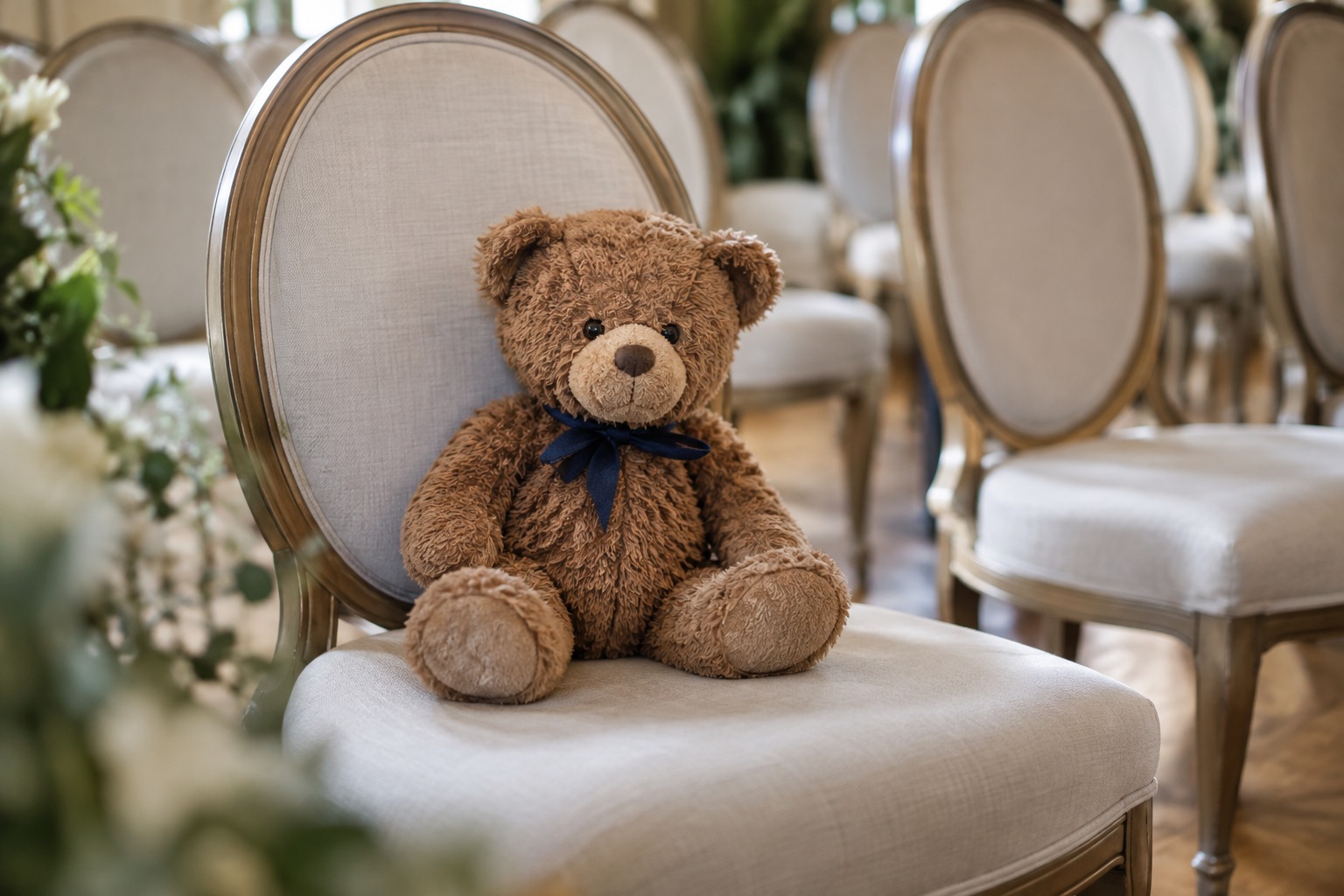
A keepsake plush or teddy bear belongs in a ceremony when it carries a person, not just a color scheme. Decide first what it represents: a grandparent, a sibling, a childhood room, a child who died, or the couple's own early years. Then give it one clear job, such as riding in a pocket, sitting on a memorial table, or being handed to a child during the vows, and let everything else stay simple.
What a keepsake plush adds that flowers cannot
Flowers mark the day. A plush marks a history. A bear that sat on a hospital bed, traveled through a move, or was sewn back together after a dog found it holds a specific record that no florist can supply. Couples who include one usually do it for one of three reasons: to represent an absent family member, to give a restless child something to hold during a long ceremony, or to make the ceremony feel less formal than the venue suggests.
That third reason is the most practical. A ceremony with a ring bearer who is four years old, a reading by a nervous cousin, and a receiving line in a cold hallway benefits from one soft object in the room. It changes the temperature of the event without changing the structure.
If the bear is old, fragile, or emotionally loaded, treat it as a document rather than a prop. That means handling rules, a designated carrier, and a plan for what happens when the ceremony ends. Owners of vintage bears often need guidance on seams, fur, and storage before they risk a public outing; a practical German-language guide to plush care, teddy bear care and repair, covers washing temperatures, invisible-stitch repairs, and long-term storage in enough detail to be useful before a wedding, not only after one.
Where does the bear go during the ceremony?
Placement is the whole decision. Pick one location and commit to it, because a bear that moves around during the ceremony becomes a distraction.
- In a pocket or small bag. Best for a very old or very small bear. A suit breast pocket, a clutch, or a fabric pouch worn under a jacket keeps it on the person without exposing it to weather or handling.
- On a memorial table. A side table near the entrance or beside the guest book, with a framed photograph and a candle if the venue allows open flame. The bear sits, does not travel, and guests can see it during the reception.
- In the hands of a child. A ring bearer or flower girl who is anxious will hold a familiar object longer than a bouquet. Choose a bear small enough to carry one-handed and washable, because it will end up on the floor.
- On the altar or ceremony table. Common in church settings, where the table already holds a Bible, candles, or a unity candle. Check with the officiant first; some churches restrict what may be placed there.
- Carried by the officiant or a reader. A quiet option when the couple wants the object present but not visible from the back row.
Whichever you choose, name the person responsible for it before the ceremony starts. "Someone will grab it" is how keepsakes get left in a vestibule.
How do you carry a fragile or vintage bear safely?
Old plush fails at predictable points: the arm joint, the neck seam, the nose stitching, and the backing behind glass eyes. Before the ceremony, inspect those four places in daylight. If a seam is opening, repair it now rather than during a receiving line.
Support the body, not the limb. Carry a bear with one hand under the torso and the other over the back, the way you would carry a small animal. Never lift it by an arm, an ear, or a ribbon. If the bear must travel in a bag, pad it with acid-free tissue or clean cotton cloth, not newspaper, and avoid plastic bags that trap moisture.
Weather matters more than most couples expect. Direct sun fades mohair and dyed cotton. Rain and snow ruin both fur and filling. A bear that spends twenty minutes on an outdoor table in August will look different by the reception. If the ceremony is outdoors, keep the bear in a shaded spot or bring it out only for photographs.
For a bear that is genuinely too fragile to travel, a substitute is a reasonable choice: a small photograph of the bear in a locket, a piece of its fabric sewn into a pocket square, or a modern plush that resembles it. The symbolic function survives the swap. The original stays home.
What about children and the transition object?
A plush that a child sleeps with is not the same object as a keepsake bear, even when it is the same bear. Child development research and common practice both describe a transition object as something a child uses to manage separation, and a wedding is a separation-heavy day: new room, new clothes, many strangers, a long period of sitting still.
If the bear serves that function, it should travel with the child, not sit on display. That means it goes in the child's bag, comes out when needed, and is not treated as decoration. Do not borrow a child's comfort object for a memorial table without asking, and do not promise to "keep it safe" if you cannot guarantee it will be returned the same day.
Age guidance for a bear in a bed is separate from ceremony use. For sleep, many pediatric and safety organizations advise keeping soft objects out of an infant's sleep space during the first year. A ceremony is a supervised, waking event, so the same rule does not apply, but a bear should never be placed in a crib or bassinet afterward as a substitute for a safe sleep environment.
Who should not be given the job
Not every willing helper is a good carrier. Someone who is already managing rings, vows, a microphone, or a toddler has enough to hold. Someone who has been drinking should not be responsible for an irreplaceable object. Someone who does not know the bear's history may treat it as a generic prop and set it down on a chair, a floor, or a wet bar.
The best carrier is usually a calm adult with no other role, who understands what the object means and is willing to leave the reception early with it if necessary. If no such person exists, choose a display location instead of a carrier. A table does not forget.
After the ceremony: the part most couples skip
Plan the return trip before the wedding day. A bear that goes to a venue in a tote bag should come home in the same bag, not in a coat pocket or a car trunk. Heat, damp, and pressure are the three common causes of damage in transit, and all three are easy to avoid.
Once home, give the bear a few hours to air in a dry room before storing it. If it was handled by many guests, a surface clean may be enough; a full wash is rarely necessary and is risky for old materials. Loose dust can be lifted with a soft brush. Persistent odors, matted fur, and opening seams are repair questions, not cleaning questions, and they are worth answering before the bear goes back into a box.
Store it flat or lightly supported, away from sunlight, in a breathable container. Do not vacuum-seal a vintage bear. Do not store it in a basement or attic where temperature swings. If the bear has a name, a date, and a story attached to the ceremony, write that down on an acid-free card and keep it with the bear. The object will outlast the memory of who carried it, and the card is what closes that gap.
Finally, decide what the bear's role means for the marriage, not just the wedding. Some couples bring it out on anniversaries. Some put it in a display case. Some hand it to a child years later. Any of those is fine. What matters is that the decision is made on purpose, on a calm day, rather than in a hallway at the end of a long night.
Source check · reviewed September 15, 2026
Source note
From the desk
Notes on the desk
Next move
Put this into a rehearsal-ready brief.
The Decision Deck stores nothing by default. It turns the questions above into a local checklist, sequence, and vendor prompts.
Keep planning
Meaning + Access
Meaningful Wedding Ceremony Traditions
Make meaning with context, consent, and care.
Meaning + Access
Accessible Wedding Ceremony Planning
Plan communication, movement, and sensory comfort early.
Meaning + Access
Gender Inclusive Wedding Language
Choose ceremony language that names the people present.
Meaning + Access