Ceremony · Updated August 23, 2026
Tartan and a Kilt in a Ceremony
How to search the Scottish tartan register by name or region, read a threadcount
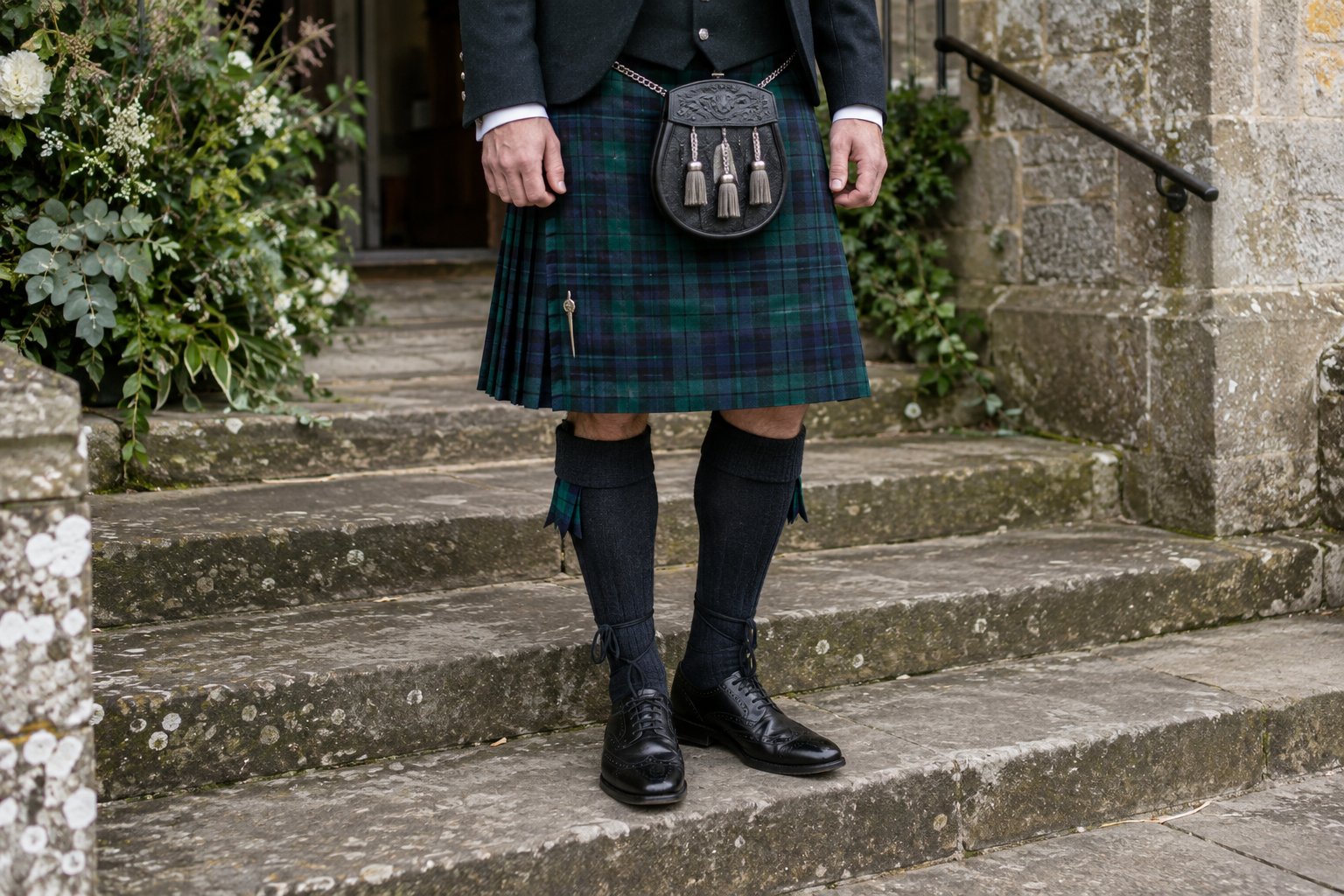
A tartan is a woven pattern, not a family crest, and the Scottish Register of Tartans is the official place to look one up. You can search it by name, by region, or by keyword, and each record shows a threadcount you can read to understand the sett. For a ceremony, the practical sequence is: find the tartan, read its threadcount, then match it to a kilt weight and yardage that suits the event.
How do I search the Scottish tartan register by name?
The Scottish Register of Tartans, maintained by the National Records of Scotland, holds thousands of recorded setts. Its search field accepts a name, and the name can be a clan, a family, a district, a corporation, or a commemorative design. Type the surname or the tartan name you have in mind and the results list each record with its registration number, its status, and a swatch.
A few habits make the search cleaner. Spelling variants matter: MacLeod, McLeod and Macleod can return different records, so try the common alternates. If you only know the clan and not the exact sett, search the clan name first and then look at the variants listed under it, because many clans have a dress, hunting, ancient and weathered version of the same pattern. The register also notes whether a tartan is restricted, which means the designer or clan has asked that it not be woven commercially without permission. That note matters if you plan to have cloth made rather than rented.
If you are choosing for a wedding party and want a plain-language walkthrough of how names, variants and restrictions sit together, the guide at tartan register name covers the search fields and the record layout step by step. It is written for wearers rather than weavers, which is the right level for most couples.
Once you have a registration number, write it down. It is the single most useful piece of information to give a kiltmaker, because it removes any ambiguity about which sett you mean.
How do I search the Scottish tartan register by region?
Regional search works differently from name search. The register indexes many tartans by district or area, so a search for a place name, a county, or a city can surface setts that are not tied to a single family. Examples in the register include district tartans named for towns, islands and historic counties.
This is useful when a couple has no clan connection, or when one partner does and the other does not. A district tartan lets the second person wear something with a real geographic link rather than an invented one. It also works when the ceremony is being held somewhere meaningful: a tartan named for that region gives the outfit a reason to be what it is.
Region search is less tidy than name search. Some places have several tartans, some have none, and the naming is not always consistent. Try the modern administrative name and the older county name, and try the island or town name on its own. If nothing comes back, the register's browse function lets you page through records by category, which is slower but catches designs that were never indexed under a place.
How do I read a tartan threadcount?
A threadcount is a written recipe for the pattern. It is usually given as a sequence of colour letters with numbers between them, for example something like B24 W4 R6, and it describes how many threads of each colour appear in the sett, in order, from the point where the pattern repeats.
The letters are colour codes: B for blue, W for white, R for red, G for green, K for black, Y for yellow, and so on. The numbers are thread counts, not inches or centimetres. A larger number means a wider band of that colour. The sequence is read in one direction and then mirrored, which is why a tartan looks symmetrical when you step back from it. The full repeat is called the sett.
Two practical consequences follow. First, the threadcount tells a weaver how to set up the loom, so it is the technical identity of the tartan, more precise than a photograph. Second, threadcount and sett size are related but not the same thing: the same threadcount woven at a heavier weight produces a larger sett on the cloth, because the threads themselves are thicker. That is why a tartan can look bolder in a heavy kilt weight than in a light fabric.
When you compare two records that look similar, the threadcount is how you tell them apart. Colours can be described loosely in prose, but the numbers are exact.
Choosing kilt weight and yardage for a ceremony
Kilt cloth is usually sold by weight and by yardage, and both affect how the outfit reads in photographs and how it feels over a long day.
Weight is expressed in ounces per yard, and the common bands are light, medium and heavy. Light cloth is cooler and drapes softly; heavy cloth holds a crisper pleat and swings less. For a formal ceremony, medium to heavy is the usual choice, because the pleats keep their line through standing, walking and sitting. Outdoor ceremonies in cold weather push the decision further toward heavy, while a summer registry office may make light cloth more comfortable.
Yardage refers to how much cloth goes into the kilt. A five yard kilt uses less cloth and has fewer, shallower pleats. An eight yard kilt uses more and produces deeper pleats and a fuller back. The difference is visible from behind, which is the view most guests have during a ceremony. Eight yard kilts are the traditional formal option; five yard kilts are lighter, cheaper and easier to move in.
Measurements matter more than either. Waist is taken at the level the kilt will actually sit, which for traditional wear is higher than trouser waist. Length is taken from that waist point to the top of the knee, and the kilt should finish at or just above the knee, not below it. A kiltmaker will usually ask for both measurements plus height, and will convert between sizing systems if you are ordering from abroad.
What else goes with the kilt, and what can be rented?
The kilt is the base layer of a larger outfit, and the accessories are where ceremonies differ most.
A sporran is the practical bag worn over the front of the kilt, since a kilt has no pockets. Day sporrans are plain leather; formal sporrans are fur or metal-topped. Hose and flashes sit below the knee, and their colour is the easiest place to pick up a secondary colour from the tartan. Brogues are the usual shoe, and ghillie brogues with long laces are the formal variant. A jacket completes the look: an Argyll jacket is versatile, while a Prince Charlie is the more formal evening option with a waistcoat and bow tie.
Rental is common for weddings, and it solves two problems at once: cost and storage. A full outfit rented for a single event avoids the cleaning and storage burden afterwards, and it lets the wearer try a weight and yardage before committing. If several people in the party need the same tartan, renting also keeps the setts consistent, which is harder to guarantee when everyone buys separately.
If you do buy, plan the care. Wool should be brushed rather than washed after each wear, aired between uses, and cleaned sparingly by a specialist. Store a kilt hanging or folded flat with the pleats protected, and keep it away from damp. Moths are the main long-term risk, so cedar or a sealed bag helps.
A short sequence for the ceremony
Start with the register: search by name if there is a family link, by region if there is not. Note the registration number and read the threadcount so you know exactly which sett you are asking for. Then decide weight and yardage against the season and the formality of the event, take waist and length measurements at the right points, and settle the accessories last, using the tartan's secondary colours as your guide. Rental covers a single day well; buying makes sense when the kilt will be worn again. Either way, the register record is the anchor for every decision that follows.
Source check · reviewed September 15, 2026
Source note
From the desk
Notes on the desk
a handmade element to wear · a ceremony in a church building
Next move
Put this into a rehearsal-ready brief.
The Decision Deck stores nothing by default. It turns the questions above into a local checklist, sequence, and vendor prompts.
Keep planning

Ceremony
Nontraditional Wedding Ceremony Ideas
A ceremony is a sequence you can make your own.Ceremony
Wedding Ceremony Script Guide
Write a ceremony script from beats, not borrowed language.
Ceremony
Wedding Ceremony Structure Examples
Three planning shapes for different kinds of gatherings.
Ceremony